

Nobody calls a dentist because things are going well. It’s usually a tooth that’s been grumbling for a week or two, and underneath the phone call is one worry: did I wait too long?
Most of the time, no. There’s no deadline on a calendar. A root canal stops being an option when the tooth can’t be rescued, and that depends more on what’s left of the tooth than on how many days you’ve put it off.
What a root canal needs to work
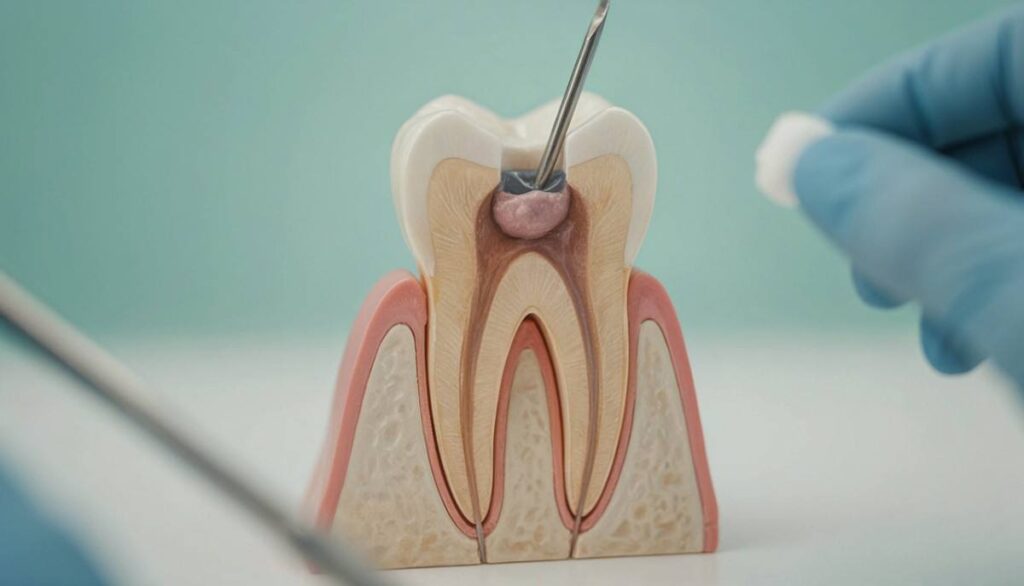
A root canal removes infected tissue from inside the tooth, cleans the inner space, and seals it to help prevent further infection. Most teeth then get a crown. All of that assumes there’s a solid tooth left to seal and cap. If there is, we can usually save it, even after weeks of infection. If there isn’t, no amount of cleaning helps.
When the tooth can’t be saved
A few situations make us tell patients the tooth is gone. Decay is the common one. A cavity left alone can eat so much of the tooth that nothing is left to hold a filling or a crown. Cracks are another. If a crack runs below the gumline or down into the root, bacteria keep getting back in, and the tooth can split.
Then there’s the bone. When gum disease has worn away enough of the bone around a tooth, the tooth gets loose, and a root canal can’t tighten it. Less often, the root itself has started to break down. Sometimes an infection returns after earlier treatment and refuses to settle. A few teeth are also just awkward inside, with canals that can’t be reached. A small procedure at the root tip can still rescue some of those, and some it can’t.
Why waiting hurts your odds
An infected nerve doesn’t clear up on its own. The bacteria multiply, push out through the tip of the root, and slowly eat into the bone. All the while the tooth is getting weaker, so the longer you wait, the more likely you are to cross one of the lines above.
I can’t give you a number of weeks. One tooth holds on for months, and another falls apart in a few. That uncertainty is the whole reason not to gamble.
When the pain stops
Everyone has the same thought: it quit hurting, so it must be getting better. Usually it isn’t. When the nerve dies, the pain goes with it, and the infection keeps going without sending any signal. Plenty of people only find out on an X-ray, when the bone damage is already visible. If the ache disappeared and nobody has looked at the tooth, book the visit anyway.
Signs worth getting checked
- Tooth pain that interrupts your sleep at night
- Hot or cold drinks that leave the tooth sore long after you’ve swallowed
- Pain when you bite down
- A small bump on the gum, like a pimple, that comes and goes
- A tooth that appears gray or darker than the surrounding teeth.
- Swelling or a bad taste around one tooth
If you notice any of these signs, contact your dentist for an evaluation. If you have two or three together, don’t wait for the next free weekend.
When it’s an emergency
Swelling that spreads into your face or neck, a fever, or trouble swallowing or breathing means you should go to an emergency room or call your dentist right away. A tooth infection can travel, and this isn’t one to sit on.
If it really is too late
Then the tooth comes out, and that’s a hard thing to hear. However, that doesn’t mean the story ends there. Your dentist can talk you through replacing it with an implant or a bridge. Please don’t skip that part. A gap lets the teeth beside it lean over, and over time your bite changes and cleaning gets harder. It’s a longer road than saving the tooth would have been, but it’s a manageable one.
What to do this week
Get an exam with an X-ray. That picture tells us how far things have gone, and guessing doesn’t. Pain medicine and antibiotics can make you more comfortable for a while, but neither one removes infected tissue from inside a tooth, so don’t count them as the fix. Chew on the other side until you’re seen. Also, ask what follow-up care the tooth may need, as many teeth treated with a root canal benefit from a protective crown.
If you’re in or around Marietta and a tooth has been bothering you, an exam is the quickest way to find out where you stand.
Conclusion
A root canal is too late when the tooth has lost too much of itself: too little structure, a deep crack, or too little bone around it. Short of that, there’s a good chance the tooth can be kept. The mistake I’d most like you to avoid is waiting for the pain to tell you what to do, because pain can vanish while the damage goes on. If a tooth feels off, get it looked at.
FAQ
1. Can I still get a root canal if the pain went away?
Often, yes. A tooth that no longer hurts may have a damaged or dead nerve rather than being healed. A dental X-ray can help identify the underlying problem.
2. How long does a root canal take?
Many are done in one or two visits. Molars have more root canals, which often makes their treatment take longer.
3. Will antibiotics fix an infected tooth?
They can slow the spread for a short time, but they can’t clean the inside of the tooth.The underlying infection still needs proper treatment.
4. Is tooth extraction a better option than root canal treatment?
Keeping your own tooth is usually the better path when it can be saved. Pulling it leaves a gap you’ll want to fill.
5. Does a root canal hurt?
The tooth is numbed first, so most people feel pressure instead of pain. Some soreness for a few days afterward is normal.
About the Author
Dr. Ray Cornay is a general and cosmetic dentist at Marietta Dental Professionals. He grew up in Newnan, GA, and earned his Doctorate of Dental Medicine at the Dental College of Georgia at Augusta University. His day-to-day work covers root canals, crowns, implants and larger rebuilding cases. He is board certified in moderate oral sedation for patients who get nervous in the chair, and he’s a member of the American Dental Association and the Georgia Dental Association.
2551 Roswell Rd., Building 100
Marietta, GA 30062
Phone: 770-514-5055
Email: staff@mariettadentalpros.com


